
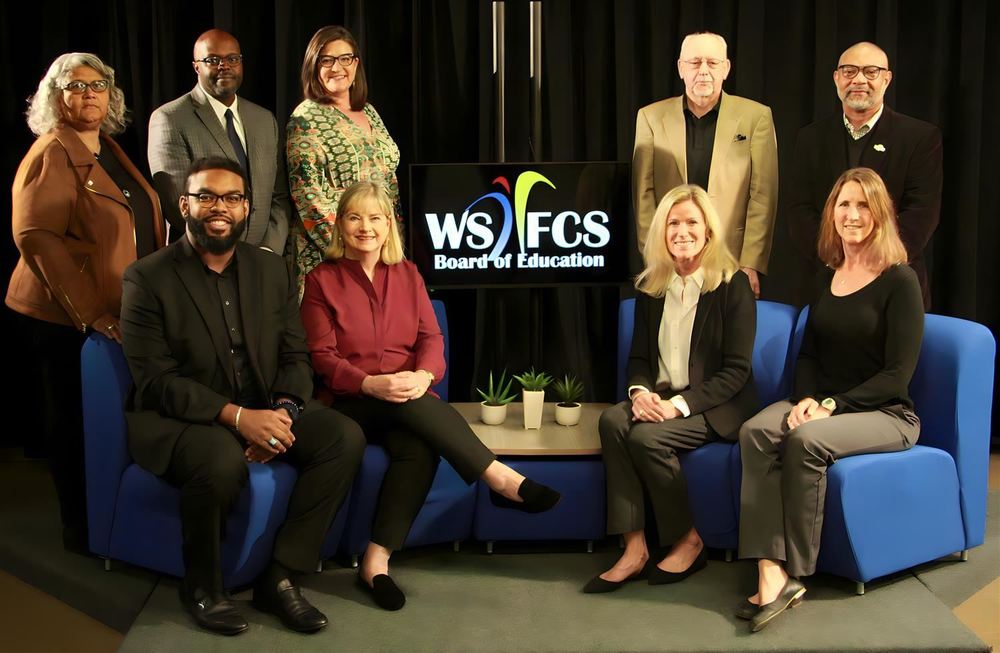
The Board of Education meeting on Tuesday, March 24 was a board workshop. No formal action was taken.
Budget Priorities
Superintendent Don Phipps addressed the Winston-Salem/Forsyth County Schools Board of Education about the earliest steps of this year’s budgeting process during a workshop on Tuesday morning.
Phipps described a budgetary strategy that emphasizes stability, maintaining the district’s level of service and maximizing the number of allotted positions and hours for staff. He says that consistency will be key to rebuilding trust among district stakeholders.
However, there are still plenty of variables at play that will impact the resources the district can use. The state government hasn’t passed a budget for this year or next year. Teacher pay increases are common but not guaranteed in election years. The Forsyth County Board of Commissioners will have to evaluate local tax revenue before making appropriations for the district. Next year’s enrollment numbers will play a part as well.
Phipps expects to present multiple budget proposals later this year that account for different levels of funding and minimize fluctuations in staffing. He asked the board and the public to keep measured expectations and be prepared for options to change as other governing bodies make their decisions.
“We’re not going to be able to restore everything that was cut. We just can’t do that,” Phipps said. “But we will figure out how much we can do… those numbers are going to vacillate, we just don’t know how much yet.”
The board will hold a workshop dedicated to further budget discussions in April.
Board Legislative Priorities
The board also discussed its legislative priorities.
Looking toward the next legislative session, the board laid out several ways that lawmakers could help the district invest in educators and student services. Some potential priorities discussed on Tuesday included:
More local control of the academic calendar
Direct deposit options for lottery funds
A new accountability model that gives more weight to student growth and less weight to a single
,standardized test given on one dayIncreased allotments for student service professionals (assistant principals, counselors, social workers, EC professionals, etc.)
Increased pay and workdays for employees
Increased funding for Pre-K
Additional funding to enhance to school security protocols
Lobbyist Sebastian King presented to the board about how hiring a lobbyist might benefit the district. Lobbyists offer an opportunity to cut through the noise by making it their full-time job to speak directly with legislators on their clients’ behalf. King said that the right lobbying strategy could lead to a massive return on investment for the district in the form of increased appropriations from the General Assembly.
“Every dollar is up for grabs, and when that happens, you need to be at the table,” King said. “If you’re not represented, it’s easy for folks to forget about you.”
Strategic Plan Discussion
The board also discussed its expectations for the next districtwide strategic plan.
The strategic plan sets guiding principles for how the board conducts business over several years. The most recent strategic plan spanned from 2020-2025 and set goals centered on student achievement, equity and access, community engagement, human resource development, and a climate of safety and support. District leaders have spent much of the 2025-26 school year surveying students, staff, and families about their priorities for the next strategic plan.
Chief of Staff Effie McMillian presented the board with a draft plan built around stakeholder feedback. This plan is centered on four key student-centric goals:
Fostering stronger academic skills in students of all backgrounds
Increasing mastery of the life skills described by the Portrait of a Graduate
Making students feel more connected and present within school culture
Preparing students for a successful future through specialized programs, work-based learning, and improved graduation rates
The draft plan also lays out strategies for recruiting and retaining qualified staff, improving communication and participation for families, and planning further ahead to maximize operational sustainability.
Superintendent Don Phipps said that the strategic plan needs to be designed to guarantee communication, clarity, connection, and consistency so that everything the district does has a clear purpose.
“Everything we do, every idea we come up with, we need to be able to point to something we’ve created to say if it helps us accomplish these overall goals that we’ve come up with,” Phipps said.
The draft plan can be viewed here.
The next regular meeting of the Board of Education will be held on Tuesday, March 31.